
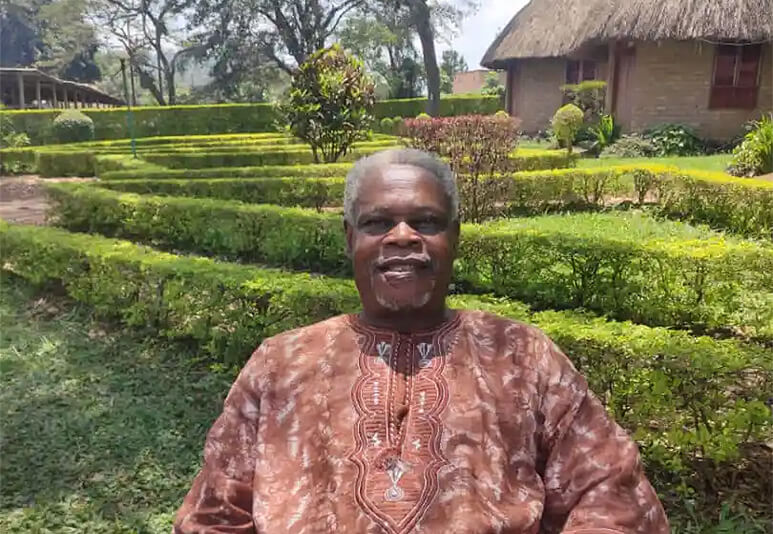
Ivan had the opportunity to interview Dr. Mwalimu Musheshe, founder of the African Rural University (ARU) for women, URDT Girls School, URDT Institute, Nkondo Secondary School, and Kanywamiyaga Primary School, Kagadi Kibaale Community Radio, and co-founder of the Uganda Rural Development and Training (URDT) program.
Ivan and Dr. Musheshe talk about how these transformational projects came to be, how structural thinking and the creative process are integral parts of these programs, as well as Creatortools’ ongoing partnership with African Rural University to offer the Creating Your Life course to ARU faculty and staff.
Ivan Fritz: So, Musheshe, for anybody who hasn’t seen the documentary [The Uganda Project] and doesn’t know yet what we’re going to be talking about, would you mind just giving us a quick timeline, and the purpose of why ARU was formed, and a brief description of where you are now?
Dr. Musheshe: Yes. I think it can be described in the historical perspective, because as you may be aware, we started the journey of rural transformation way back with the founding of African Food and Peace Foundation and the Uganda Project. And with the Uganda Project, the idea was to work with the communities, and especially the younger generation, to equip them with skills and capacities with which they can use to do self-help work, become self-reliant, and become good citizens.
As you may recall, we were coming out of a number of wars, and there was a lot of powerlessness, a lot of hopelessness, and the idea was how to give young people and the nation new hope. And therefore, the application of the principles of structural dynamics was handy, right from the 1980s. Unfortunately, we got interrupted when the Uganda Food and Peace Project had issues. And that’s how we started the Uganda Rural Development and Training Program, to continue the work of the Uganda Project and the Uganda Food and Peace Project, using the same principles and the same approach.
Ivan Fritz: And when was that?
Dr. Musheshe: That was 1987. When we were designing our constitution [for URDT] with Silvana Franco Veltkamp [of the African Food and Peace Foundation] and Ephrem Rutaboba, we included our old dream of starting an institution, and that’s why the objective end included the establishment of the African Rural University working with the government, again in order to put the education at a higher level of research, inquiry, and program designs a little bit more diverse than just skilling, skilling, and skilling. So that was the basis of starting the African Rural University. Then the next thing was who should be the agents that we can work with, train very fast, and also have the ability, the interest, and the attributes of change agency. And that’s how we decided to be an all-women university.
However, we could not start it because in the area where we were, there were very few educated girls. The dropout rate was very high. Education was very low. So then we said, okay, why don’t we start with the lower education, and then progressively go upwards.
That’s why we started the girls’ school for girls from very poor families, and then we nurtured them, and eventually we had a good population that we could start off with African Rural University.
The intent is to train the young people in agriculture, [train] the young people in the environment, [train] the young people in health, water, and sanitation, and of course, business and entrepreneurship, and enable them to create conditions for themselves to do self-help projects, and help also the communities to learn how to organize themselves. And that’s why the questions of, “what are your aspirations as an individual?,” “what are your aspirations at the household level?,” “what are the aspirations at the community?,” and “what is the situation like now?,” and “what do you need to do in order to move where you are to the desired state?,” so that it becomes uniformly in schools, in communities and higher institutions. And that has been the basis. And again, the continuation of the work of African Rural University.
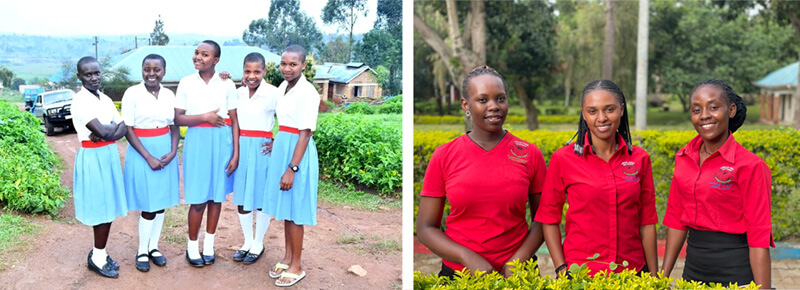
Students from the URDT Girls School and from the African Rural University
Ivan Fritz: Which is a really amazing story, but it’s also an amazing mission. I think that the approach of systemic institutionalizing of the creative processes is really fascinating, especially for me, because very rarely do you get to see it so intentionally taught. You’re also not just training the girls at the URDT Girls School; you’re training their families at the same time. I’m curious now that you’ve had multiple generations go through it. What does the community look like? What kind of effects are you seeing after so many decades of this work?
Dr. Musheshe: I think there are two or three prongs. Prong number one was using the tool, which was called the Illustrated Village Technologies for Creating, which our students were using while working with the communities in the villages. And that was designed to be 18 weeks long. The experiences, the young people we are gathering, plus our staff, were documented to inform the curriculum and the program at the university.
And then later, from the Illustrated Village Technologies for Creating, we designed the principles of creating for the university as a course. Complementary to it, we also created what we called, from the work of Peter Senge and also Robert Fritz, “The Learning Institution,” using the principles of Systems Thinking.
So now, by applying those to both schools and communities, you are already implementing the two-generation approach: You start to see a transformation from the individual young girl, creating leadership at the family level, mobilizing the family members to think through what they want to create. What kind of household do they want, where they are, and what kind of activities can they do together as a productive unit.
We have seen communities tremendously changed. I think we have about 1000 households that have moved from objective poverty to actually thriving. Prosperity, creating shops, creating farms, building family houses, and most importantly sending other siblings and young people of the household to better schools.
Then we have seen, of course, also roads being made in the communities, and communities transforming how they eat, how they dress, how they work, and the leadership roles they take in their communities.
So yes, we have seen transformation unfolding before our eyes. However, as they say, we are seeing the tip of the iceberg because the community is not homogenous; the community is not small, but at least the idea has taken root. Everyone is no longer talking about “vision” as a word; they are talking [about] “vision” as a concept. They are using it properly. It is taught in schools. It has been adopted by the state. We have Uganda Vision 2040. We have Vision 2030 for Rwanda, Vision 2030 for Tanzania. So the concept is taking root by fire. There have been a lot of forces, including ourselves, to propagate the thinking in this new direction, and changes are taking place. We have a lot of evidence for that.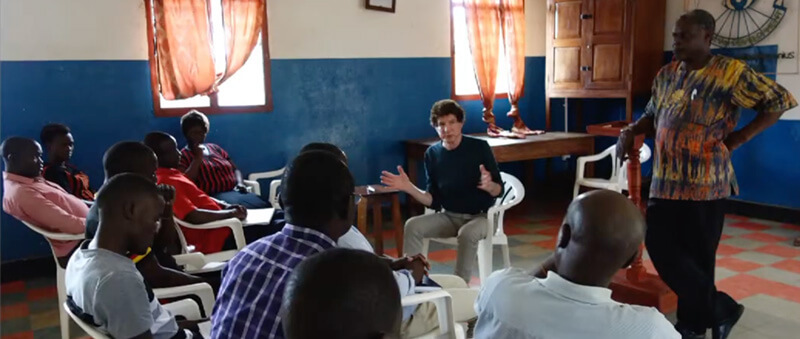
Robert Fritz and Dr. Musheshe in Uganda
Ivan Fritz: That is really incredible. So it sounds like it’s not just ARU now? Are the principles spreading to other schools as well?
Dr. Musheshe: I think it’s having an effect on other schools because we are now, from 2012, we are working with 20 primary schools. And we are also practicing the two-generation approach. We have now gotten a new fund from social initiatives in Sweden. We have adopted 10 more schools, and we will fill those schools again with the principles of creating and structural dynamics. Then we are working with our graduates of African Rural University in the project that is funded by the Mastercard Foundation, of skilling the youth. The core focus for training the young people is the introduction and the practice of Structural Dynamics, Systems Thinking, entrepreneurship, and leadership development.
So, it is no longer just at ARU. Our graduates have taken it to the field. They have taken it to the districts, and we are graduating hundreds of young people. I think on Saturday, no, Sunday, last Sunday, we graduated 700 young people, and the guest of honor was the Minister of Finance and Economic Planning.
So yes, it is spreading, and it is reaching there. Of course, there are many things that need to be done to consolidate, to make it a way of life, to move people from oscillation. Because it is a new development paradigm. There are already existing paradigms. We are still experiencing some oscillations, and people are still sitting in the rocking chairs. But there are those people who also have become fluent and doing a good job.
Ivan Fritz: So with all these changes and adoption, has that changed the aid landscape at all? What does it look like in Uganda for you now? Is it still problem-solving oriented?
Dr. Musheshe: As they say, old habits die hard. The international community, and even learning institutions, even at the higher level, you will find they have on their walls what they call “mission statements.” You’ll find on their walls what they call “vision statements,” but then in the structure of their programs, they still have what they call the “problem statement.”
Even the researchers, you tell them this is the aspirations of the community. This is what we are going to do: community action planning based on the principles of creating. And someone says, “Yeah, I know you are going to do research, but where is your problem statement you are going to research on?” And we’re saying, “No, we are researching on creating new conditions, creating new results.” In our research, certainly we shall recognize problems as part of current reality.
So those oscillations are there. But I think as we see more and more start talking using the language, both in words, and they’re moving towards concepts. They are trying to do some practice, and our work is how to engage with them so that there is a progressive shift without being Pentecostal about it.
So, luckily enough, I’m incorporated in the National Planning Authority Board. That’s the language. We produced Uganda Vision 2040. So we are faced in that direction. The language is getting thick in there. Luckily enough, I’m a member of the Uganda Vice-Chancellors. Here, they call them Vice-Chancellors, meaning university president. And we are about 56 presidents of different universities. Now, this year, they put me on the executive committee, and I’m the chairman of training and curriculum development.
Ivan Fritz: Really amazing. And you’re having your staff, I understand, go through our course, the Creating Your Life course online. So my question is, what is the thinking behind that, and how do you see it fitting into your plans for the future?
Dr. Musheshe: Yes. Because I think the Ugandans have been told that in order to be effective, people should work in groups and cooperatives. My study and my experience have shown that creating a group or a cooperative, and introducing the principles of structural dynamics, principles of creating as a group, the dynamic of disturbance is bigger.
Because individually, they don’t have the experience and they don’t have the fluency. So this training in “Creating Your Life” makes an individual grounded in the principles. They can practice them at the individual level, so when they join hands with others, they are not now arguing about how the principles work — they are looking at how they can deal with shared vision rather than arguing on the principles of structural tension and other things.
So the power of the individuals to collectively work together because they know what they are doing has a bigger multiplier effect than when you introduce it at the group level. And then you are helping them to become fluent at the individual level within the group. And then the misunderstanding, the interpretations, and whatever, I think that creates a very dangerous dynamic.
So with me, I’m happy that the individuals are learning how to create as individuals, and they’re creating individuals when they come together. Then it becomes very easy. So now we shall be talking about the alignment and the synergy rather than how the principles work.
Ivan Fritz: That makes total sense. So does that mean then, moving forward, as new people join as instructors or as staff members, they would also just go through that as part of their initial kind of orientation?
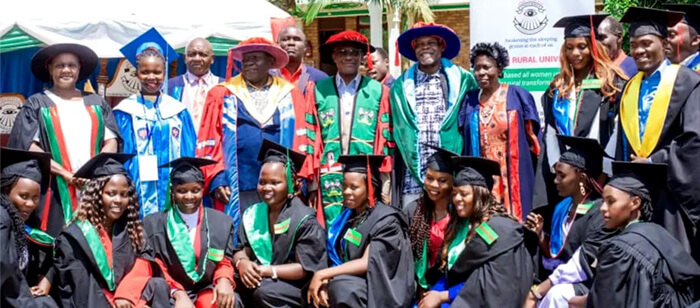
Dr. Musheshe with 17 ARU graduates / Rural Transformation Specialists
Dr. Musheshe: Actually, the good news is that the university council has made it a policy that all the staff should undergo this training. That’s number one.
Number two, the members of the council every year put aside three days to go through these methodologies. Now, let me tell you what was very interesting. Very recently, we presented a policy on community engagement. The director of community engagement shared the policy with the chairman of the council. The council wrote back “No, the language of the creative process is not articulated very well.” I told the guys to go back to the drawing board. Now they have written the second, I think the third version, to satisfy the council because they can now tell which language we are using in relation to our methodology and which language is traditional from problem solving.
To me, I think that is a very big success and a step moving in the right direction. So, therefore, progressively, we are institutionalizing the methodology. We used to call it the vision and approach. We are talking about structural dynamics. We are talking about systems dynamics, and it is going to become the way of life, the way of doing things at the institutional level, right from our lower classes to the institute to the university. And now to the communities.
And luckily enough, it is also becoming now a language of everyone out there. So we are not going to be strangers, but we should be helping them to refine more how the principles are applied beyond the words, to practice. So, yes, our long-term vision. And I don’t think it is even long-term, because we are already putting it into practice. So our journey is how to institutionalize these principles of structural dynamics.
And my work is to mobilize resources, but essentially it is to internally strengthen the capabilities and the capacities of the staff to deliver on structural dynamics and systems dynamics. And to also mentor and work with the members of the council, but also create a bridge between myself and our organization, our schools, our institutions, and the government institutions. So that then we can see how much we can share and influence the way the other institutions are moving towards the application of Structural Dynamics in their daily life, and the lives of the institutions.
We need to work more and create more young people who are demonstrating how it works.
Because I think our strength has been from talking about it to demonstrating how it works in the lives of individuals, how it works at the household level. How institutions are working and creating change in terms of development, roads, water, health facilities, and how the national country now has what we call Uganda Vision 2040. And I have been a participant in the design of that program.
Ivan Fritz: Very cool. Thank you so much. I really appreciate your time.
This is a transcript of a recorded interview and has been lightly edited for clarity.
© 2026 Creatortools Inc.
Photos of Dr. Mwalimu Musheshe and students from URDT Girls School from the URDT website. Photo of Robert Fritz and Dr. Musheshe from the film The Uganda Project. Photos of students from ARU and graduating class from the ARU website. | Layout and introduction: Jen Thornton